President Donald Trump is in France for the 2026 G7 summit after securing a U.S.-Iran peace deal.
G7 leaders will discuss on Wednesday the security risks posed by AI and social media on the last day of a summit dominated by Donald Trump, before host French President Emmanuel Macron dines with his US counterpart at the Palace of Versailles.

The three-day summit of the leaders of Canada, France, Germany, Italy, Japan, Britain and the United States has focused intensely on Trump’s deal to end the war with Iran and efforts to pressure Russia into brokering peace with Ukraine.
The third and final day of the G7 summit focuses on AI and social media, with CEOs from OpenAI, Anthropic and European rival Mistral meeting leaders for lunch on Wednesday. French President Emmanuel Macron has invited his US counterpart Donald Trump to a private dinner at the lavish Palace of Versailles after the three-day summit wraps up.
Donald Trump et Emmanuel Macron au G7 à Evian le 15 juin 2026. Crédit : Ludovic MARIN / AFP
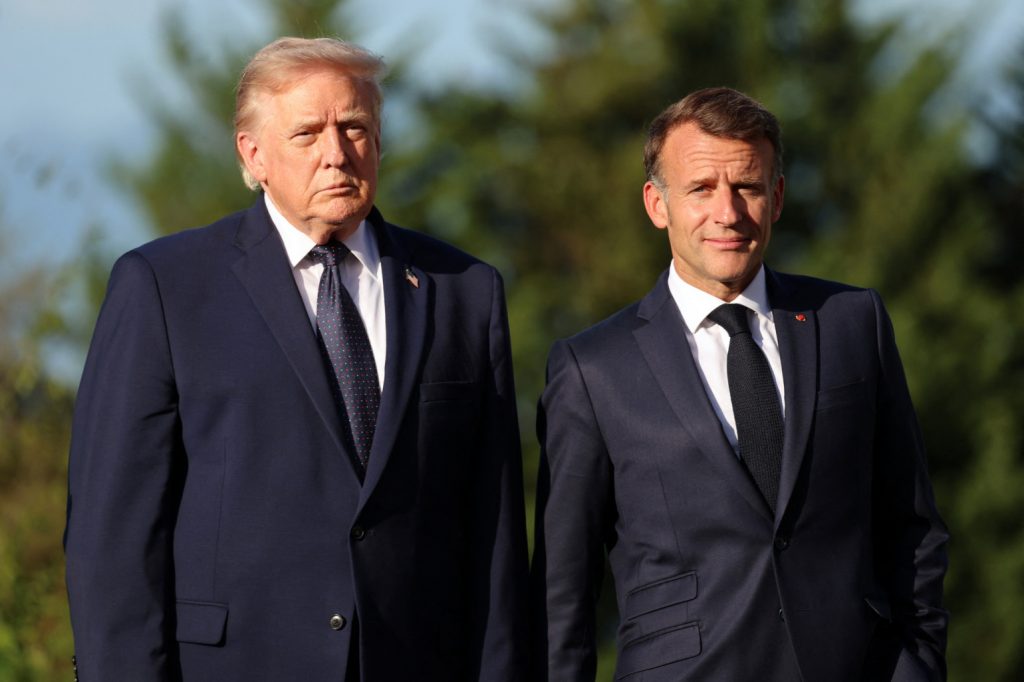
Trump said the United States was under “no obligation” to invest in Iran after the deal, adding that its main focus was that Iran would not acquire a nuclear weapon and that “all hell” would “rain down” on the country if it did.
On Ukraine, Trump has moved to a more hostile stance against Moscow, saying Russia should “make a deal” and indicating Washington could re-impose waived sanctions.
Iran and the situation in the Middle East will be one of the dominant talking points at the G7 summit, along with security for Ukraine, balancing economic growth disparity and the future of artificial intelligence.
European leaders have welcomed the agreement reached between Washington and Tehran, and will use the summit to push for clarity on the reopening of the Strait of Hormuz.
“The Strait of Hormuz must reopen, and freedom of navigation must be restored — toll-free,” European Commission President Ursula von der Leyen said in a statement on Monday, calling for a ceasefire in Lebanon to also be brokered.

“This crisis also carries a clear lesson,” she added. “Once again, we have seen our energy dependency being weaponized. We will discuss how to reduce our dependence on transit through the Strait.”